
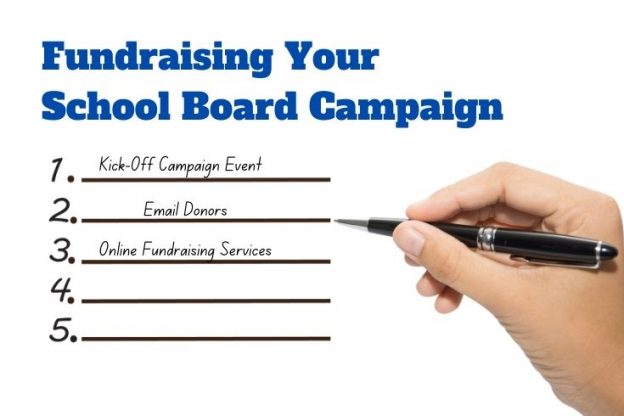
School board races are local, but they are not cost-free. Even a modest campaign may need money for a website, signs, printed literature, mail, donation-processing fees, and other voter outreach.
Fundraising allows a candidate to communicate beyond family, friends, and existing community contacts. Without a budget, candidates may spend heavily on one visible item—usually signs—then have little left for literature, mail, online communication, or final voting reminders.
The goal is to determine what a credible campaign will cost and make sure the necessary funds are available when costs occur and bills come due.
A fundraising plan should answer five questions:
- How much will the campaign cost?
- When will the money be needed?
- How much can the candidate contribute personally?
- Who is likely to contribute, and how will the campaign ask?
- Who will maintain the records and file the required reports?
Some school board candidates can run largely self-funded campaigns with a limited number of signs and printed materials. Others compete across large districts where direct mail, advertising, professional services, and broader voter outreach require a lot more money.
There is no useful national average for the cost of a school board campaign. To get an idea of what you may need to spend, go over the financial disclosures from several recent candidates in your district, and get current prices for the materials and services you expect to use. That will give you a more realistic starting point than a general campaign-cost estimate.
Check the Rules Before Raising or Spending Money
Campaign-finance requirements may begin before your name appears on the ballot. Accepting a contribution, spending personal money, ordering signs, or paying for a campaign website can trigger registration or reporting obligations.
Before money changes hands, find out:
- Whether the candidate or campaign committee must register
- Whether a treasurer is required
- When a campaign bank account must be opened
- Who may contribute
- Whether contribution limits apply
- What donor information must be collected
- Whether cash contributions are restricted
- How candidate contributions and loans are reported
- What disclaimers must appear on fundraising material
- When campaign-finance reports are due
The office that accepts your ballot paperwork may not administer campaign finance. Ask which agency handles candidate registration and financial reporting, then obtain its current handbook, forms, filing calendar, and recordkeeping instructions.
Review the school board filing process.
Estimate the Cost of the Campaign
List the likely expenses and obtain actual quotes where possible. Broad estimates for categories such as “advertising” or “printing” are less useful than knowing what a specific sign order, postcard mailing, or website will cost.
| Expense | What It May Include | What Can Increase the Cost |
|---|---|---|
| Campaign website | Domain name, design, hosting, donation integration, and updates. | Custom design, content setup, added pages, photography, or outside technical help. |
| Signs | Yard signs, stakes, larger signs, and delivery. | Quantity, size, additional colors, shipping, and replacement signs. |
| Printed literature | Flyers, door hangers, palm cards, brochures, and postcards. | Paper quality, full-color printing, multiple versions, design, and rush production. |
| Direct mail | Voter data, design, printing, addressing, and postage. | District size, number of mailings, household selection, and postage rates. |
| Digital outreach | Email service, online advertising, text messaging, and campaign software. | List size, message volume, advertising spend, creative work, and data services. |
| Fundraising | Invitations, venue costs, food, payment-processing fees, and event material. | Venue rental, catering, permits, insurance, and low attendance. |
| Professional services | Photography, design, consulting, legal advice, and accounting. | Custom work, short deadlines, compliance questions, and multiple revisions. |
| Final voter contact | Voting reminders, final mail, replacement signs, and volunteer material. | Unexpected competition, a runoff election, or additional printing. |
Keep part of the budget uncommitted. Candidates often need another printing, replacement signs, additional mail, or voting reminders late in the race.
Understand the Different Sources of Campaign Funds
Campaign funds may include contributions from the candidate, loans, individual donations, and donated goods or services. These may be treated differently for reporting purposes.
Record personal spending and donated services from the beginning. A supporter who pays for printing, provides professional services, or supplies an event venue may be making an in-kind contribution.
Donated goods and services may still have a reportable value. Examples can include free graphic design, printing, food, event space, professional photography, or signs purchased directly by a supporter.
If the candidate pays a campaign bill personally, record the payment when it is made. Depending on local rules, it may be treated as a candidate contribution, loan, or reimbursable expense.
Begin With People Who Know You
Early contributions often come from relatives, friends, colleagues, neighbors, community contacts, and people who encouraged the candidate to run.
Create a starting list that includes:
- Family members and close friends
- Current and former colleagues
- Business and professional contacts
- Neighbors and longtime district residents
- Community and nonprofit contacts
- Former candidates and local officials
- People concerned about the same district issues
This is a prospect list, not automatically an email subscription list. Keep personal outreach records separate from the list of people who have agreed to receive campaign email.
Make a Direct Request
A fundraising request should explain:
- Which office you are seeking
- Why you decided to run
- What the campaign is preparing to do
- How much you are asking the person to contribute
- How the contribution can be made
Weak request: “Please donate whatever you can to support the campaign.”
More useful: “We are raising $2,500 before September 1 to print our first mailer and place signs with supporters. Would you consider contributing $50 or $100?”
Use amounts that fit the campaign and comply with local contribution limits.
Example Fundraising Call
“I wanted to let you know that I am running for the Area 2 school board seat. I entered the race because the district faces major facilities and budget decisions, and I believe my project-management experience would be useful on the board.
We are raising money for our first mail piece and sign order. Would you consider contributing $100 to help us get started?”
After asking, allow the person to answer. Remember, money isn’t everything. Someone who cannot contribute may still be willing to volunteer, display a sign, attend an event, or introduce you to other residents.
Use Letters, Email, and Social Media to Support Fundraising
Written appeals work best when they give supporters a reason for the request. Best practices mean that there is an explanation of what the campaign is doing and what, specifically, the money will fund.
Example: “We are 18 donors away from paying for our first districtwide postcard. A contribution of $25 or more will help us introduce the campaign before early voting begins.”
A letter to close friends can be more personal than an email to a broader list. Social posts can report progress, promote an event, or explain a current campaign expense. Repeating the same “donate now” message without new information gives supporters little reason to respond.
See school board campaign fundraising letters and announcements.
Accepting Online Donations
An online donation page makes it easier for supporters to contribute after they receive an email, speak with the candidate, attend an event, or visit the campaign website. The page handles the transaction. The campaign still has to explain why the contribution is needed.
Choose a Service Designed for Political Campaigns
For most local candidates, a fundraising platform designed for political campaigns is easier to manage than a general business payment processor.
A political fundraising service may provide:
- Campaign-specific donor information fields
- Contributor eligibility certifications
- Contribution-limit controls or warnings
- Campaign disclaimer fields
- Recurring donation options
- Refund and chargeback records
- Reports and donor-data exports
- Automatic deposits to the campaign bank account
- Integration with campaign websites and email
Generic payment processors may accept a payment without collecting all the information your campaign needs for financial reporting, such as employer or other disclosures. That can leave the treasurer reconciling transactions manually or having to contact donors later for missing information.
Compare political donation platforms and fundraising services
Questions to Ask Before Choosing a Fundraising Platform
- Does it serve nonpartisan school board candidates?
- What transaction, monthly, setup, or service fees apply?
- Does it collect all donor information required in your jurisdiction?
- Can it prevent or flag contributions over the legal limit?
- Can donors make recurring contributions?
- How quickly are funds deposited?
- How are refunds, disputes, and chargebacks handled?
- Can records be exported in a format the treasurer can use?
- Does the campaign retain access to its donor data?
- Can the form be embedded on the website, or does it use a separate hosted page?
- Does it allow campaign branding and required disclaimer language?
- Is the form easy to complete on a phone?
- What happens to the account and data after the campaign ends?
Review the full pricing structure rather than comparing only the percentage charged per transaction. Also check donor-tip settings, payout timing, refund terms, account termination policies, and data-export options.
Test the Donation Process
Complete a small test contribution before distributing the link. Test the link from the campaign website, email, and social media. A correct donation-page URL is not helpful if a campaign button or email link points somewhere else.
What to Put on the Donation Page
The page should contain enough information to confirm that the donor is supporting the correct campaign without repeating the full campaign platform.
- Candidate name and office
- Committee name where applicable
- A short reason to contribute
- Suggested contribution amounts
- A custom amount option
- Required donor-information fields
- Eligibility certifications and legal notices
- Campaign disclaimer
- Contact information for contribution questions
After the contribution is completed, direct the donor to a thank-you page or message. That confirmation can also provide links to volunteer, request a sign, join the email list, or share the campaign.
Track Contributions and Donor Information
The campaign needs one reliable record of contributions, even when donations arrive through several sources.
Money may come through:
- The online fundraising platform
- Checks received by mail
- Contributions collected at events
- Candidate contributions or loans
- In-kind goods and services
- Refunded or returned contributions
Assign one person—usually the treasurer or someone working directly with the treasurer—to maintain the financial record. Avoid keeping separate, conflicting spreadsheets maintained by several volunteers.
Information to Record
| Information | Why It Matters |
|---|---|
| Donor name and address | Identifies the contributor and may be required for reporting. |
| Email address and telephone number | Allows the campaign to send a receipt, resolve missing information, or follow up with permission. |
| Employer, occupation, or other required details | Some jurisdictions require additional contributor information. |
| Date and amount | Establishes when the contribution was received and how much was given. |
| Aggregate contribution total | Helps the campaign monitor contribution limits across multiple donations. |
| Payment method | Distinguishes online payments, checks, cash where permitted, and other forms. |
| Gross contribution, processing fee, and net deposit | Allows the treasurer to reconcile platform activity with bank deposits. |
| Fundraising source | Shows whether the donation came from an email, event, call, letter, website, or other appeal. |
| Refund, return, or chargeback status | Documents money that was not retained by the campaign. |
| Thank-you and follow-up status | Prevents duplicate messages and helps the campaign maintain supporter relationships. |
Reconcile Online Donations With the Bank Account
Donation platforms may combine several contributions into one bank deposit and deduct processing fees before sending the money.
Do this regularly rather than trying to reconstruct months of activity shortly before a financial report is due.
Protect Donor Information
Campaign records may contain home addresses, employment details, contribution history, and other personal information.
- Limit access to people who need the records.
- Use individual accounts rather than sharing one password.
- Enable multifactor authentication where available.
- Store exports and spreadsheets in a controlled location.
- Do not send complete donor files through unsecured group email.
- Remove access when a volunteer or consultant leaves the campaign.
- Retain or dispose of records according to applicable requirements.
Follow Up With Donors
Send a prompt acknowledgment that confirms the contribution and thanks the donor. A payment processor receipt may document the transaction, but a separate campaign message makes the acknowledgment more personal.
A donor follow-up can include:
- A thank-you from the candidate
- A brief campaign update
- The website and campaign contact information
- An invitation to volunteer or display a sign
- Information about an upcoming event
- Any language required by local rules
Do not make every message another fundraising request. Updates about campaign progress, forums, endorsements, voting dates, and volunteer needs give contributors other ways to remain involved.
Fundraising Events
A small event can raise money and introduce the candidate to supporters. It can also consume time and money without producing much net revenue.
Possible formats include a house gathering, breakfast, coffee event, meet-and-greet, issue discussion, or online event.
Example Event Calculation
A campaign expects 30 attendees and requests $50 per person. The event could produce $1,500 before expenses.
But if the venue, food, invitations, supplies, and payment fees cost $900, only about $600 remains for the campaign. A smaller gathering hosted by a supporter might bring in less revenue but produce more net proceeds.
Raffles, auctions, alcohol, games of chance, and the use of school or public property may involve additional rules. Check before promoting the activity.
What First-Time Candidates Often Underestimate
Through Online Candidate, we see candidates add a donation button to a website and expect contributions to follow. The button gives supporters a way to pay, but the candidate still has to ask.
Other recurring problems include:
- Raising money without a budget. The campaign cannot explain how much it needs or what the money will fund.
- Waiting too long to ask. Websites, signs, printing, and mail often require payment early.
- Using only broad appeals. A specific goal gives supporters a reason to contribute now.
- Failing to report personal spending. Candidate purchases may still need to be recorded and disclosed.
- Choosing a processor that does not collect required donor data. Missing information creates more work for the treasurer.
- Not reconciling deposits. Platform payouts, fees, refunds, and bank deposits must match.
- Counting pledges as available money. Do not commit funds that have not been received.
- Spending too much early. Keep money available for the final voting period.
- Stopping after Election Day. Reports, unpaid bills, refunds, remaining funds, and committee-closing requirements may still need attention.
Example of a Small Fundraising Plan
Consider a candidate who estimates that the campaign will cost $6,000. The candidate plans to contribute $1,000 and raise $5,000 from supporters.
| Stage | Goal | Planned Use |
|---|---|---|
| Before launch | $1,500 | Website, initial printing, registration costs, and first sign order. |
| Early campaign | $2,000 | Literature, voter data, events, and additional signs. |
| Main campaign period | $1,500 | Mail, digital outreach, and continued voter contact. |
| Final voting period | $1,000 | Voting reminders, final printing, replacement material, and reserve. |
The amounts are only examples. Build the schedule around actual local costs and the dates when campaign bills must be paid.
School Board Campaign Fundraising Checklist
- Confirm registration and reporting requirements.
- Identify the treasurer or person responsible for financial records.
- Open the required campaign bank account.
- Review recent campaign reports from the district.
- Estimate the major campaign expenses.
- Set an overall fundraising goal and schedule.
- Create an initial donor prospect list.
- Prepare a short fundraising explanation and direct request.
- Choose a political fundraising platform.
- Set up and test the online donation process.
- Record donations, loans, personal spending, fees, and in-kind support.
- Reconcile online payouts with the bank account.
- Thank contributors and record communication preferences.
- Add all reporting dates to the campaign calendar.
- Reserve money for final voter contact.
- Complete post-election reporting and committee-closing requirements.
Campaign-Finance Resources
- Online Candidate: Comparing Political Donation Platforms
Compares partisan and nonpartisan fundraising services, platform features, pricing considerations, donor tracking, and website integration. - U.S. Election Assistance Commission: Who Runs Elections in My State?
Helps candidates identify the state and local offices involved in election administration. - New York State Board of Elections: Campaign Finance
Includes candidate registration, disclosure, filing, reporting, and campaign-finance resources. - Texas Ethics Commission: Local Candidate Resources
Provides campaign-finance materials for school board candidates and local filing authorities. - California Fair Political Practices Commission: Candidate Toolkit
Provides campaign-finance guidance for state and local candidates. - Your state and local campaign-finance authorities
Use their current instructions for contribution limits, donor information, committee registration, advertising disclosures, reports, record retention, and post-election obligations.
Related School Board Campaign Guides
- Plan your school board campaign
- Write campaign fundraising letters
- Set up a school board campaign website
- Use email during the campaign
Start preparing for your campaign well in advance. There are no short-cuts in elections. One must put in the time and effort to organize a successful campaign, and be a consistent voice in the community if they want to clinch a victory.
Connect Fundraising to Your Campaign Website
A campaign website gives supporters one place to learn why you are running, review your priorities, contribute through your selected fundraising service, volunteer, and contact the campaign.
Online Candidate provides campaign website packages for school board candidates and other local races.