A school board campaign slogan is a short phrase used with the candidate’s name. It may identify the campaign’s main concern, emphasize the candidate’s experience, or just make the name and office easier to remember.
A slogan is optional. Something as simple as “Jones for School Board” may work better than trying to tack on a slogan that could belong to any candidate in any district.
 Your slogan doesn’t need to explain the entire campaign. It should support the reason you’re running and fit the way you describe your candidacy on your website, signs, literature, and social media.
A useful school board election slogan should:
- Be short enough to read quickly
- Fit the candidate’s actual background and priorities
- Use words voters will understand
- Work with the candidate’s name and office
- Avoid promises the school board can’t deliver
- Remain usable throughout the campaign
Start With the Reason You’re Running for School Board
Before choosing a slogan, write down why you decided to run and what you want voters to remember about you.
For example:
- A finance professional may emphasize budgets, planning, or accountability.
- A teacher or school administrator may emphasize educational experience.
- A parent advocate may focus on communication or student services.
- A construction manager may focus on facilities and long-term planning.
- A longtime community volunteer may emphasize local service and listening.
The slogan should come from your campaign message, not the other way around. Don’t choose a phrase about fiscal responsibility if the campaign never explains the candidate’s financial experience or budget priorities.
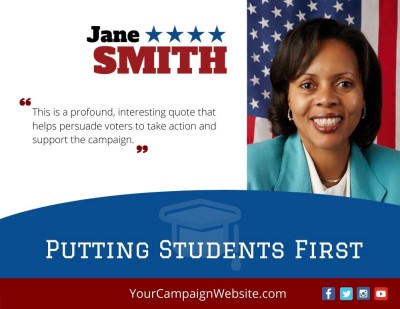
For example, “Putting Students First” won’t tell voters much unless the campaign explains what that means when the board faces decisions about staffing, programs, facilities, transportation, or taxes.
Name and Office Slogans
A name-and-office slogan is often the safest choice. It doesn’t make a broad promise, and it keeps the focus on the information voters need when they reach the ballot.
- Jones for School Board
- Jane Smith for Board of Education
- Vote Carter for District 3
- Elect Maria Lopez to the School Board
- Daniel Carter for North Valley Schools
A straightforward name-and-office line isn’t a failure of creativity. In a local election, getting voters to remember the correct name may be more important than giving them another general phrase to remember.
Student and Education Slogans
These slogans place students, classrooms, or education at the center of the campaign.
- Putting Students First
- Working for a Better Classroom
- Strong on Education
- Improving Our Schools
- A Better School for a Better Tomorrow
- Better Schools for a Better Tomorrow
- The Foundation of Tomorrow
- Academic Progress for Every School
- Supporting Students. Strengthening Schools.
These phrases may fit a candidate with classroom, student-services, parent-advocacy, or education experience. They can also work when the campaign’s priorities involve achievement, attendance, staffing, curriculum, or student support.
The weakness is that many education slogans are broad. Nearly every school board candidate claims to support students and better schools. And who doesn’t? But your campaign still needs to explain what the slogan means in the local district.
Budget, Planning, and Accountability Slogans
These slogans may fit candidates with experience in finance, management, contracting, construction, public administration, or long-term planning.
- Our Budget, Our Education
- Clear Budgets. Better Communication.
- Responsible Planning for Our Schools
- Better Planning. Clearer Decisions.
- Accountability for Every Tax Dollar
- Experience for the Decisions Ahead
- Planning Today for Tomorrow’s Schools
- Facts Before Final Votes
A budget slogan shouldn’t suggest that cutting spending is always the goal. School boards must consider educational needs, staffing, facilities, contracts, state requirements, taxes, and the district’s long-term obligations.
Communication and Community Slogans
These phrases emphasize listening, public information, or the connection between the district and the wider community.
- A Voice for Our Schools
- Listening to District 3
- Clear Communication. Open Decisions.
- Schools and Community Working Together
- Your Voice for Better Schools
- Stronger Schools. Stronger Community.
- Local Experience. Community Service.
- Working With Families, Not Around Them
This type may fit a candidate whose campaign grew out of poor district communication, limited public participation, or experience working with community organizations.
Be careful with “voice” slogans. Board members don’t serve only the people who agree with them or the group that helped elect them. The campaign should show that listening includes parents, employees, students, taxpayers, and other residents.
School Board Change and New-Direction Slogans
Some school board races develop around dissatisfaction with current leadership, spending, communication, academic results, facilities, or district policy.
- Your Vote for Change
- Restore Our School District
- A Better District for a Better Tomorrow
- A New Direction for North Valley
- Change With a Plan
- New Leadership. Clear Priorities.
- It’s Time to Ask Better Questions
- Moving Our Schools Forward
A change slogan should say more than “the current board is wrong.” Voters will also want to know what the candidate would do differently and whether that approach falls within the board’s authority.
“Restore Our School District” is a strong statement. It implies that something has been lost or damaged. A candidate using it should be prepared to explain what needs to be restored and how.
Safety and School-Climate Slogans
The original slogan page included “Stop Violence in Our Schools.” Safety may be a central issue in a district dealing with threats, fights, bullying, building access, emergency planning, or student behavior.
- Stop Violence in Our Schools
- Safe Schools. Ready to Learn.
- Safety, Support, and Accountability
- Safer Schools Through Better Planning
- Secure Schools. Supported Students.
Safety slogans can sound stronger than the candidate’s actual authority. A board member can help review policies, budgets, staffing, facilities, reporting, and district performance, but no one can personally guarantee that no harmful incident will occur.
Experience and Service Slogans
These slogans emphasize the candidate’s qualifications rather than one district issue.
- Experience for District 3
- Prepared to Serve North Valley
- Experience That Fits the Work
- Local Service. Practical Experience.
- Ready for the Decisions Ahead
- Proven Community Service
- Experience. Preparation. Service.
This approach works best when the biography supports it. “Experience That Fits the Work” should be followed by clear examples involving budgets, employees, contracts, education, public service, facilities, or another part of board responsibility.
“Passionate for Education” is less useful because passion can’t be measured and doesn’t tell voters what the candidate has done. A candidate may still use that idea, but it should be connected to actual experience.
Should You Use a Negative Slogan?
A slogan can criticize current conditions without becoming a personal attack. “Clear Budgets. Better Communication.” points to weaknesses while keeping the focus on how the candidate would serve.
A phrase aimed directly at another candidate or board member may dominate the campaign and become difficult to use if the facts or race change.
Before choosing a negative slogan, ask:
- Is the statement accurate?
- Can the campaign support it with public information?
- Does it explain what the candidate would do differently?
- Will it still make sense several months from now?
- Does it sound appropriate when placed next to the candidate’s name?
A slogan shouldn’t rely on anger alone. It should give voters some idea of the alternative the candidate is offering.
Be Careful With Humor and Wordplay
A clever slogan may attract attention, but it can also make the campaign look unserious or distract from the candidate’s name.
Humor is particularly risky when the district is dealing with layoffs, school closures, safety incidents, tax increases, or other difficult decisions. Before using a rhyme, pun, or joke, test it with people who aren’t part of the campaign. Ask what they think it means and whether they can remember the candidate’s name afterward.
Don’t force a rhyme around a candidate’s last name simply because it’s available. Clear wording is more useful than a line that sounds like a student class president election poster.
Test the Slogan Before Using It
Put the slogan beneath the candidate’s name and office. Then look at the complete design rather than judging the words by themselves.
Check whether the slogan:
- Can be read on a yard sign
- Fits naturally in the campaign logo
- Sounds normal when spoken aloud
- Matches the biography and issue pages
- Could be confused with another candidate’s slogan
- Has been used prominently by another campaign or organization
- Creates an abbreviation or hashtag with an unintended meaning
Search the full phrase before committing to it. Common campaign language may already be in use, but copying a distinctive line from a nearby candidate can create confusion and become an unnecessary campaign issue.
Using the Slogan in the Campaign Logo
Many candidates include the slogan directly in the campaign logo. That can work when the phrase is short and remains secondary to the candidate’s name.
It’s often useful to create two versions:
- A primary logo containing the candidate’s name and office
- A second version that includes the slogan
This gives the campaign more flexibility. The shorter logo may work better on social profiles, small advertisements, and some signs, while the slogan version can be used on the website, brochures, and larger graphics.
Review school board campaign logo guidance.
Use the Slogan Consistently
Once the campaign has approved the slogan, use the same wording and punctuation throughout the campaign.
Don’t use several slightly different versions. Changing “Clear Budgets. Better Communication.” to “Better Budgets and Open Communication” on another campaign piece weakens the consistency.
A slogan can be changed when it creates a real problem or no longer fits the campaign, but make the decision early. A later change may require new signs, literature, graphics, and website updates.
What We See Candidates Get Wrong
We often receive a slogan after the campaign logo and website have already been designed, which means the phrase must be forced into layouts that weren’t created for it.
We also see candidates choose a general slogan before deciding what they want the campaign to say. The result is often a phrase such as “A Better Tomorrow” or “Putting Students First” that could fit every candidate in the race.
- Choosing the slogan before defining the campaign message. The phrase doesn’t connect to the candidate’s background or priorities.
- Trying to cover too much. The slogan becomes a full sentence containing several issues and promises.
- Using claims without support. Words such as “proven,” “trusted,” and “experienced” appear without examples.
- Making the slogan larger than the name. Voters remember the phrase but not the candidate.
- Copying a popular national slogan. The wording may carry associations that don’t fit the local race.
- Changing it repeatedly. Signs, websites, mail, and social graphics stop matching.
- Using language that exceeds board authority. The slogan promises outcomes one board member can’t guarantee.
The best school board candidate slogan is usually the one that still sounds accurate after a voter reads the candidate’s biography and priorities.
More School Board Candidate Slogan Ideas
The examples on this page are starting points. Adapt them to the candidate’s name, experience, district, and reason for running rather than copying a phrase that could belong to anyone.